Uppers, Welts, & more
INTRODUCTION
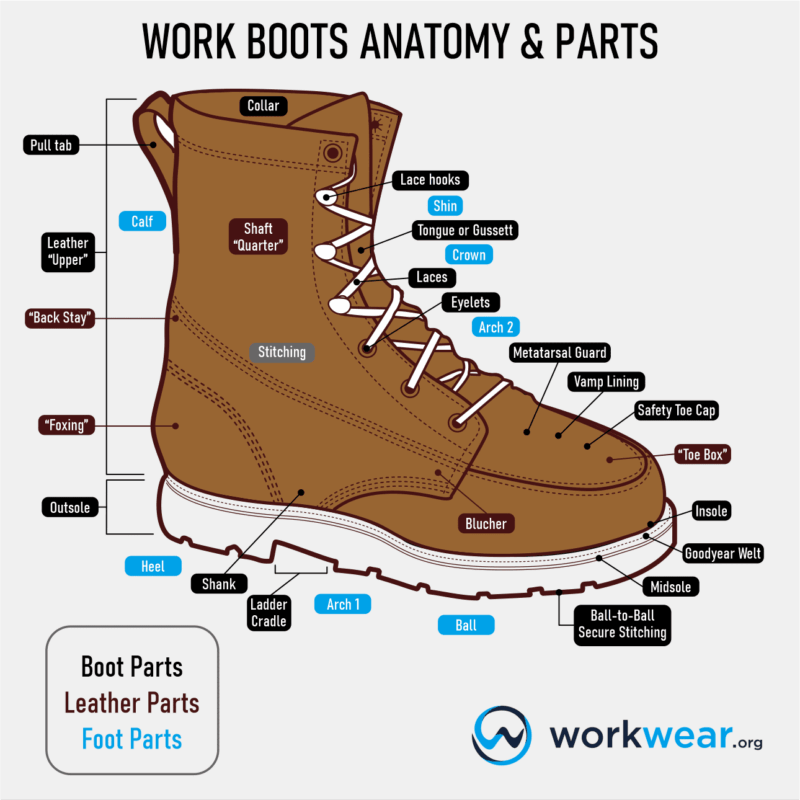
In this second part of our Rhino Safety Shoes Guide, we take a closer look at the different components that make each boot unique. Every part—from the uppers to the lining, welts, insoles, and outsoles—plays an important role in fit, comfort, durability, and protection. This guide explains these features in simple terms so you can better understand what goes into a high-quality Rhino boot.A Quick Illustration of Boot Parts (Text-Based Diagram)
This is a generic (non-Brand) boot sample with various parts labeled
BOOT PART DESCRIPTIONS
UPPERS
Uppers are the entire top portion of the boot that covers the foot. They provide structure, support, and determine breathability and durability.-
- Full Lining A complete interior layer that covers the entire inside of the boot for comfort and moisture control.
-
- Full Grain Leather High-quality leather taken from the top layer of the hide is known for strength, durability, and natural resistance to wear.
-
- Leather A general term for hides treated for flexibility and durability. Used for everyday work applications.
-
- Premium full Grain Leather Top-tier hide offering maximum toughness, long life, and a refined appearance.
-
- Tumbled Full Grain Leather Leather softened in a Drum to achieve a flexible feel and a naturally textured finish.
-
- Nubuck Leather top-grain leather that’s lightly sanded to create a velvet-like texture while remaining strong.
-
- Premium Nubuck Leather Higher-grade nubuck with a smoother, more uniform finish and improved durability.
-
- Split Suede The inner layer of the hide, buffed for a soft feel. offers flexibility and a rugged, matte appearance.
-
- Double Fitting Loops Two loops that are located near the collar to help pull the boot on quickly and easily.
-
- 1000 denier Cordura A strong Nylon fabric is used on boot uppers for abrasion resistance and lightweight durability.
-
- 1000 Denier Nylon Tough, flexible nylon is used in high-wear areas for strength and breathability.
-
- Waterproof A construction method and material system that prevents any water from entering the boot.
-
- Water Resistant Repels moisture but is not fully waterproof. It is designed to slow down water penetration.
LINING
Inside material that keeps the foot comfortable, manages moisture, and adds insulation when needed.-
- 100–200g Thinsulate Lightweight insulation that traps warmth without bulk—ideal for cooler environments.
WELTS
The strip of material connecting the upper to the sole.-
- Regular Welt A standard welt attachment provides strength and durability.
- Goodyear Welt A premium welt component known for durability and easy resoling.
COLLAR
The padded top rim around the boot opening. It cushions the ankle and improves comfort.TONGUE
The strip of material under the laces protects the top of the foot and keeps debris out.-
- Padded Tongue Extra cushioning for comfort and pressure reduction from the laces.
- Gusset A tongue connected to the sides of the boot to prevent dirt, water, and debris from entering.
- Gusset with speed laces A gusseted tongue paired with hooks that allow fast lacing and easy adjustments.
INSOLES
Inside footbeds that determine comfort and support.-
- Cushion Insole Provides soft comfort for long hours of standing or walking.
-
- Contoured Insole shaped to follow the foot’s natural arch for improved support.
-
- Removable Insole allows easy replacement, cleaning, or upgrading to custom inserts.
-
- P/U (Polyurethane) Insole shock absorbing and long-lasting, ideal for high-impact work.
OUTSOLES
The bottom layer of the boot is responsible for traction, stability, and durability.-
- EH (Electrical Hazard) Outsole Approved for extra protection against accidental contact with electrical circuits.
-
- Injection Molded Outsole A single-piece molded sole for flexibility and long-term durability.
-
- oil and slip-resistant Provides traction on slick, oily, or wet surfaces.
-
- Natural Rubber Offers strong traction and flexibility with a sturdy feel.
-
- MC Rubber A durable rubber blend designed for grip and resistance to abrasion.
-
- MC Rubber Wedge A wedge-shaped outsole for stable footing and even weight distribution.
-
- Dual Density Rubber Grip Two layers of rubber for comfort and improved ground traction.
-
- Dual Density EVA Rubber Combines cushioned eVA with rubber for impact absorption and durability.
-
- natural gum rubber Soft, flexible, and known for excellent grip.
-
- Heavy Tread Rubber Grip Deep tread pattern for maximum traction on rugged terrains.
-
- Stretched Around Cemented Rubber A construction method that gives added durability around high-stress areas.
-
- Rubber with Gripping Design System Outsole engineered with multi-directional patterns for superior traction.
-
- Rubber Lug Deep, aggressive lugs for outdoor and industrial work.
-
- Mustang Natural Rubber A proprietary rubber blend offering superior flexibility and grip.
-
- Natural Rubber – 2 Color Slip & Oil Resistant Dual-tone rubber is designed for dependable slip and oil resistance.
-
- Water Tread Slip & Oil Resistant The outsole is designed for wet environments, providing extra grip.
-
- Traction Tread Direct Attached A sole attached directly to the upper for comfort and flexibility.
-
- P/U Heeled Polyurethane-heeled design for durability and comfort on varied terrain.
-
- P/U 90° Heeled A squared-off heel for climbing, ladder work, and improved stability.
-
- Waterproof Outsole and boot construction are designed to prevent water penetration.
-
- Water Resistant Helps repel water but is not fully waterproof.
TOE COVERS
-
- Protective toe covers and reinforces the toe area for additional durability and protection. Steel toe and Composite toes are examples.
-
- Rubber toe bumper a rubber overlay added to the toe area to reduce wear in high-impact zones.
UNDERSTANDING ARCH SUPPORT AND SHANK MATERIALS
Even though Rhino Boots are made exclusively for long-term comfort to prevent foot fatigue and to enable stability, this next section includes information about Many types of shank materials to expand your knowledge of work boot components. When people think about work boots, they often focus on toe protection and outsoles—but arch support and internal shank materials are just as critical. These components play a huge role in foot fatigue, stability, and long-term comfort. This is especially important during long shifts on hard or uneven surfaces. Many people — including buyers, institutions, and even manufacturers — blur the terminology arches and shanks. The shank is a rigid or semi-rigid piece embedded between the insole and outsole. Its job is to:-
- Support the arch of the foot
- Stabilize the midfoot to Prevent excessive flex.
-
- Improve load distribution and ladder stability
-
- The shank is a structural component inside the boot.
-
- The arch support is the function or result that the shank (and insole/midsole) provides.
Steel Shank
Steel shanks are the most traditional and strongest form of arch support used in work boots. They run between the insole and outsole, reinforcing the midfoot and preventing the boot from bending excessively. Key Characteristics- Extremely strong and rigid.
- Excellent load-bearing support.
- Provides superior ladder and shank stability.
- Steel arch support is ideal for heavy-duty jobs where workers carry significant weight, climb ladders, or stand on narrow surfaces.
- The rigidity helps distribute body weight evenly across the foot, reducing strain on the arches and heels.
- It also prevents the boot from collapsing in the midfoot over time.
- Steel shanks add weight to the boot and may feel stiff at first.
- They also conduct temperature, which can make them feel colder in winter environments.
-
- Construction and industrial work
- Roofing and ladder-heavy jobs.
-
- Workers who require maximum stability and long-term durability.
Wooden Shank
Wooden shanks are a classic, old-school solution that has been used in work boots for generations. While less common today, they are still valued for their natural rigidity and comfort. Key Characteristics-
- Naturally firm with slight flex
-
- Lightweight compared to steel
-
- Moldable over time
- Wood shanks gradually conform to the shape of the wearer’s foot, creating a custom-like arch support over time.
- They provide a solid structure without the cold feel of metal.
- They offer good shock distribution when standing or walking for long periods.
- Wood is not as strong as steel.
- May degrade faster in extremely wet environments if not properly sealed.
- Better suited for dry or moderately demanding conditions.
-
- General labor and warehouse work
-
- Construction
-
- Roofing
-
- Long hours of standing
-
- Workers who prefer natural materials and moderate rigidity
Polyethylene (PE) Shank
Polyethylene (PE) shanks represent the modern, lightweight evolution of arch support materials. They are engineered plastics designed to balance, flexibility, support, and weight reduction. Key Characteristics-
- Lightweight and flexible.
-
- Non-metallic and non-conductive.
-
- Resistant to moisture and corrosion.
- PE shanks provide enough structure to support the arch while allowing natural foot movement, making them comfortable for walking-intensive jobs.
- Because they don’t conduct heat or electricity, they are ideal for electrical work and extreme temperature environments.
- They also reduce overall boot weight, which helps limit fatigue.
- While durable, PE shanks are not as rigid as steel, so they may not be ideal for heavy ladder work or carrying extreme loads.
-
- Light to medium-duty work.
-
- Warehouse, delivery, and logistics jobs.
-
- Electricians and temperature-sensitive environments.
Comparing Arch Support Materials at a Glance
| Shank Material | Strength | Weight | Flexibility | Best Use |
|---|---|---|---|---|
| Steel | Very High | Heavy | Low | Heavy-duty, ladders, construction |
| Wood | Moderate | Medium | Moderate | Standing work, general labor Construction Roofing Correctional Facilities |
| Polyethylene (PE) | Moderate | Light | High | Walking-intensive, electrical work |
Why Arch Support Matters More Than You Think
Poor arch support leads to fatigue, knee pain, back strain, and even long-term foot issues like plantar fasciitis. Choosing the right arch and shank material ensures:-
- Better posture.
- Reduced foot fatigue.
- Increased job-site safety.
- Longer boot lifespan.
Rhino boots match their footwear to the demands of their job.
COMING SOON PART III – BOOT SOLES
The many ways boots differ in their construction is incredible. I hope I have provided you with information that can be used to drive your sales. The next and final part of this blog will be Boot Soles. I will send out an email when Part III becomes available. Please feel free to add a comment. I would love to hear your thoughts about this blog.Copyright 2026 – Happy Daze Media/Atlantic Surplus USA All rights reserved.